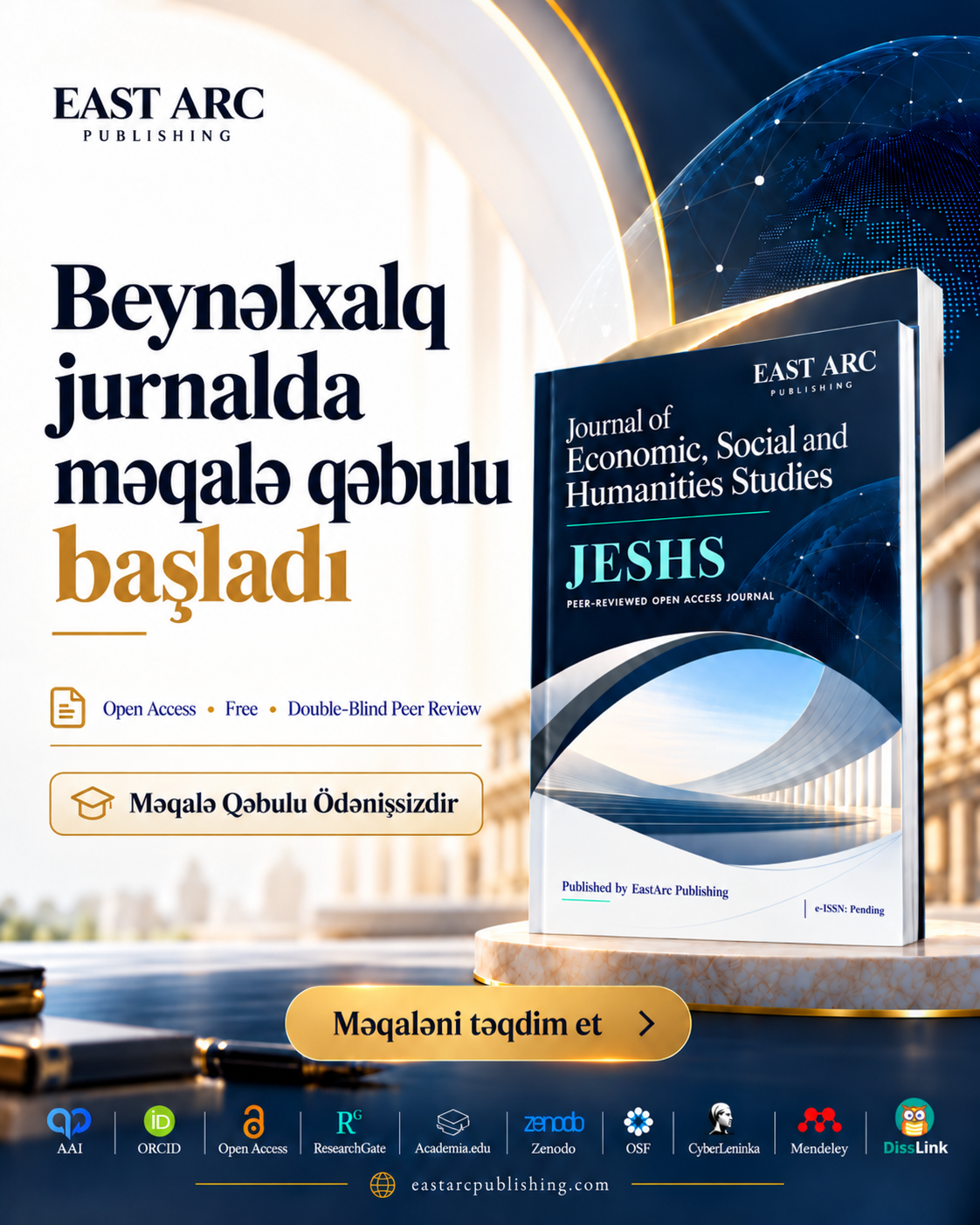
A call for papers with free publication is now open. Published by EastArc Publishing, JESHS — Journal of Economic, Social and Humanities Studies invites manuscripts in economics, social sciences and humanities for its November 2026 issue. Under the announced call for this issue, manuscript submission, peer review and publication are free of charge.
Researchers, lecturers, teachers, master's students and doctoral candidates can submit original work in Azerbaijani, English, Turkish or Russian. This guide explains the research scope, review model, manuscript structure, abstract requirements and online submission process so that authors can prepare a coherent and complete submission.
What kind of journal is JESHS?
JESHS is an open-access scholarly journal operating a double-blind peer-review model. It aims to bring theoretically and practically relevant research in economics, social sciences and humanities into scholarly circulation. Interdisciplinary work should explain the conceptual or methodological connections between the fields it addresses.
What does open access mean for readers?
Articles published under the Open Access model are freely accessible to readers. This allows people without institutional subscriptions to consult the full text. Making findings accessible can support scholarly discussion, teaching and the consideration of results in subsequent research.
Free publication for the November 2026 issue
The announced call covers a waiver of submission, peer-review and publication charges for the specified November 2026 issue. The waiver does not change the scientific assessment. Editors and reviewers consider scope, originality, methodological justification, research integrity and the quality of the presentation.
How is the publication schedule determined?
Articles that complete editorial assessment, independent review and any necessary revisions in time are planned for the November 2026 issue. Submission does not automatically secure publication in that month. The final date depends on completion of the review process, author revisions and editorial production.
Understand the scope of the fee waiver
This call concerns the specified November issue. Conditions for other issues and separate services may differ. Any charges for external services, such as a required similarity and AI-screening report, are separate from the journal's submission, review and publication waiver.
Which research areas does JESHS cover?
Economics & Business
This section covers macroeconomics and microeconomics, finance, banking, management, marketing, entrepreneurship, labour economics, the digital economy and innovation. A manuscript should identify a clear economic or business problem, justify its analytical approach and support its conclusions with suitable evidence.
Social Sciences
Relevant areas include sociology, political science, international relations, public administration, social policy, education, communication and media studies. Studies involving surveys, interviews or other human-participant data should explain sampling, data collection and relevant ethical procedures.
Humanities
The scope includes linguistics, literature, translation, history, philosophy, cultural studies, anthropology, archaeology, folklore, religion and heritage studies. Authors working with texts, archives or corpora should specify their units of analysis, selection criteria and interpretative procedures.
Choose an appropriate article type
The journal considers original research articles, systematic and analytical reviews, theoretical and conceptual studies, methodological papers and scientifically grounded case studies. A commentary based only on personal opinion, without a research method or supporting sources, may not meet the journal's scholarly requirements.
How does double-blind peer review work?
Under Double-Blind Peer Review, authors and reviewers do not know each other's identities during assessment. Research articles that pass the initial editorial checks are sent to at least two independent experts. Reviewers assess originality, methods, analysis, the support for conclusions, references and ethical compliance. The final editorial decision rests with the journal.
Prepare an anonymised review manuscript
Enter author details separately in the online system. The main review file should not contain names, affiliations or directly identifying information. Check Word comments and document properties as well. Follow the portal's instructions when supplying a separate title page containing author details.
Respond carefully to reviewer comments
A decision may request minor or major revisions, accept the article or decline it. When revisions are requested, answer each comment individually, identify where changes were made and provide a scholarly explanation where you disagree. A clear response document helps editors and reviewers assess the revised manuscript.
JESHS author guidelines and Word formatting
Prepare the manuscript in the official Word template and submit it as a .DOCX file. The supplied guidelines specify A4 pages with margins of 2.5 cm on the left, 1.5 cm on the right and 2 cm at the top and bottom. Use Times New Roman, 12 pt, 1.5 line spacing and justified alignment for the main text.
Title and author information
The article title should be concise, informative and preferably 10–15 words long. Format it in 14 pt bold uppercase text, centred. Main section headings are 14 pt bold, with subheadings at 12–13 pt bold. Prepare a relevant UDC/UOT/PACS classification code and each author's full name, institution, department, city, country, ORCID and email address.
Abstracts and keywords
The supplied template requires three equivalent abstracts, each normally 180–250 words, with 3–6 keywords in each language. Briefly present the research problem, objective, methods, principal findings, scientific novelty and practical significance. Do not introduce results absent from the article, tables or unexplained abbreviations.
- Manuscript in Azerbaijani: abstracts in Azerbaijani, English and Russian.
- Manuscript in English: abstracts in English, Azerbaijani and Russian.
- Manuscript in Turkish: abstracts in Turkish, Azerbaijani and English.
- Manuscript in Russian: abstracts in Russian, Azerbaijani and English.
For manuscripts submitted in English or Turkish, the guidelines provide for the publisher to prepare the Azerbaijani abstract during publication. Authors should confirm that the final version accurately reflects their research. Clarify any submission-specific questions about the language set with the editorial office.
How should the article be structured?
The Introduction establishes the problem, research gap, objective and principal contribution. The Literature Review or Theoretical Framework critically compares earlier studies. Explain how those studies inform the research question rather than simply listing publications.
Methods, results and discussion
The Methodology should specify the design, data sources, study period, sample selection, variables, analytical procedures and limitations. Present findings systematically in the Results section. Use the Discussion to explain their meaning and relationship to previous research. The Conclusion should state the scientific novelty and practical significance clearly and separately.
APA 7 references, tables and figures
Use the APA 7 author–date referencing system. Every in-text citation must correspond to an entry in the reference list, which should be alphabetical and unnumbered. Include page numbers for direct quotations and a DOI hyperlink where available. Number tables and figures consecutively, refer to each in the main text and provide appropriate source notes.
Research ethics and the final submission check
The manuscript must not have been published previously as a full article or be under simultaneous consideration elsewhere. All authors should approve the submission. Prepare statements on funding, conflicts of interest and data availability, together with ethics approval and informed consent where applicable.
Check before submitting
- The topic fits one of the three research sections.
- The DOCX manuscript follows the official template and is anonymised for review.
- Abstracts, keywords and APA 7 references are complete.
- Author identities, ORCID records and corresponding-author details are correct.
- Required similarity and AI-screening reports, declarations and supplementary files are ready.
Academic visibility and reaching a scholarly audience
JESHS aims to improve the discoverability of research and its accessibility to an international scholarly audience. Its website presents information relating to Google Scholar, AzPublish Academic Index (AAI), ORCID, ResearchGate, Academia.edu, Zenodo, OSF and other academic platforms. These have different roles: ORCID supports researcher identification, scholarly networks facilitate communication and repositories support access to research materials.
How can visibility support citation opportunities?
A clear title, accurate abstract, relevant keywords and consistent author identification can make a study easier to find. Readership and future citations also depend on the topic, quality and scholarly use of the work. An author's h-index is based on actual citations. The journal can support visibility but cannot guarantee a particular citation count or h-index increase.
How to submit your manuscript to JESHS
- Read the journal scope and author guidelines.
- Download the official Word template and prepare the manuscript.
- Create an EastArc Publishing author account or sign in.
- Complete the title, abstracts, keywords and author information in the online system.
- Upload the main manuscript, required reports and supplementary materials.
- Check and submit the application, then monitor editorial notifications.
Prepare your research for the JESHS November 2026 free publication call. Explain its scholarly contribution clearly, follow the manuscript requirements and contact the editorial office through its official channels when you need guidance.
Submit your manuscript online →
Author guidelines and Word templates →
Download the English DOCX template ↓ | Azerbaijani DOCX template ↓
Contact: journal@eastarcpublishing.com
#JESHS #EastArcPublishing #CallForPapers #FreePublication #InternationalJournal #OpenAccess #PeerReview #Economics #SocialSciences #Humanities #AcademicPublishing #Research #DoctoralResearch #AuthorGuidelines #AzPublish