
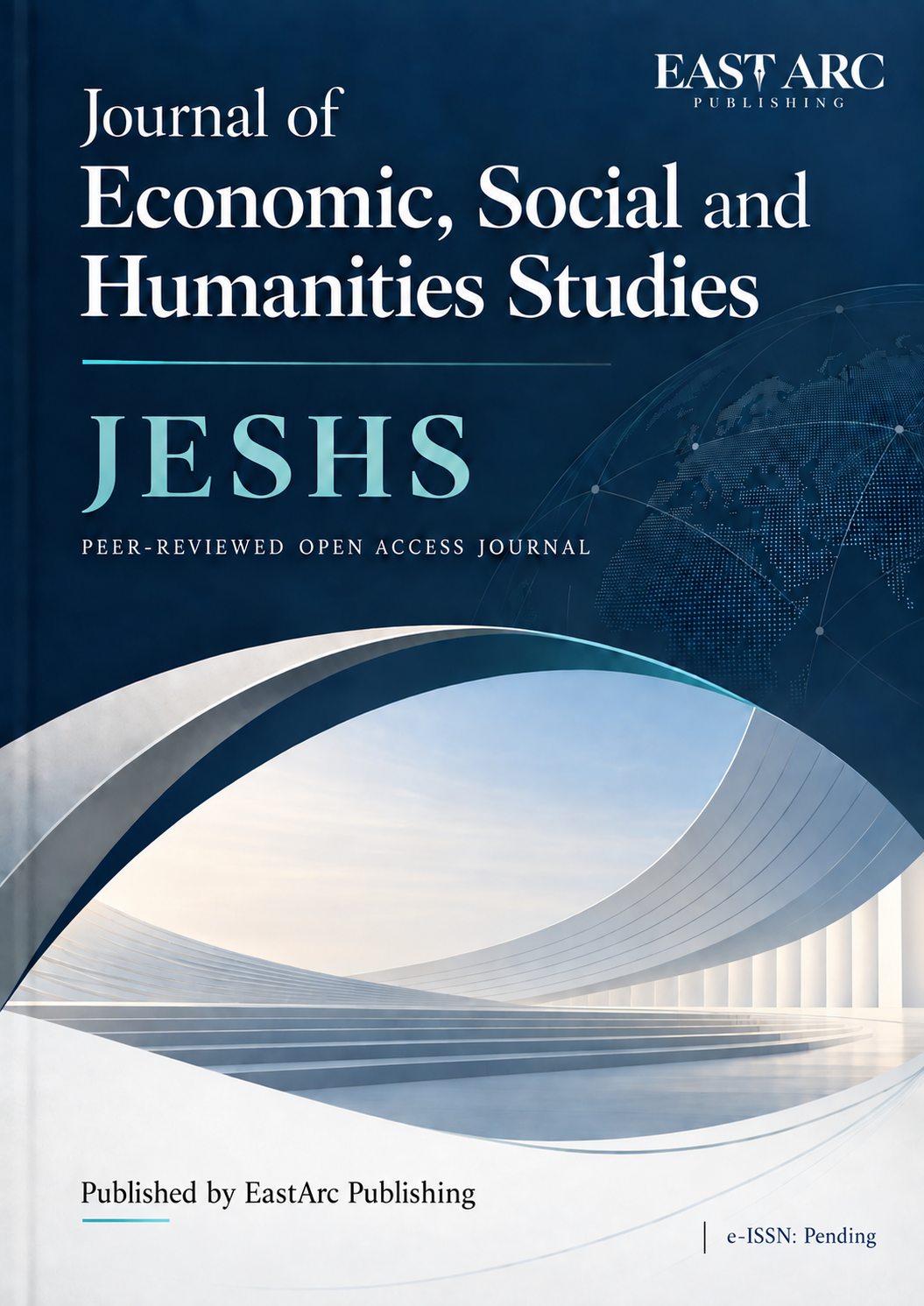
Choosing a journal involves more than finding a title related to your research. Authors need to examine its scope, manuscript requirements, review model and publication charges. If your work concerns economics, social sciences or humanities, consider exploring the Journal of Economic, Social and Humanities Studies — JESHS. Published by EastArc Publishing, the journal brings together theoretical, empirical and interdisciplinary research.
In this AzPublish guide, we explain the journal’s subject areas and the requirements authors should review before submitting. The information will help you assess whether your research fits the journal and prepare a complete submission. Visit the official JESHS page.
About EastArc Publishing and JESHS
EastArc Publishing is an independent international academic publisher based in Baku, Azerbaijan. Its stated principles include open access, academic editorial oversight, transparent peer review and wider access to scholarly knowledge. JESHS applies this approach to the study of economic, social and humanities questions.
The journal encourages research on national and regional issues as well as comparative and international perspectives. Submissions should offer a clear research question, an appropriate method, supported findings and a contribution to scholarly discussion. A topical subject needs a research design that explains what was examined, which evidence was used and how the conclusions were reached.
First issue and publication schedule
The official website lists Volume 1, Issue 1 (2026) as being prepared, with no published issues currently available. The announced schedule is six issues a year, one every two months, with each calendar year forming one volume. This schedule does not guarantee the review or publication time of an individual manuscript. Progress depends on editorial assessment and any revisions requested.
What research does JESHS cover?
Economics and business
The scope includes macroeconomics, microeconomics, finance, banking, management, marketing, entrepreneurship, labour economics, the digital economy and innovation. Articles in these fields should connect the research problem to a suitable conceptual framework and explain the evidence and methods used. The discussion should show how the findings address the original question.
Social sciences
JESHS covers sociology, political science, international relations, public administration, social policy, education, communication and media studies. Survey research, interviews, documentary analysis and other approaches should be justified in relation to the study’s aims. Research involving human participants must address the relevant requirements for ethical approval and informed consent.
Humanities and interdisciplinary research
Linguistics, literature, translation, history, philosophy, cultural studies, anthropology, archaeology, folklore, religion and heritage studies form the humanities scope. The journal also supports comparative work combining economic, social and humanities perspectives. Read the full aims and scope.
Article types and submissions in four languages
The journal accepts original research articles, systematic and analytical reviews, theoretical and conceptual studies, methodological articles and academically grounded case studies. Personal opinion pieces without supporting sources or a research method may not meet its academic requirements.
Manuscripts may be written in Azerbaijani, English, Turkish or Russian. Every article requires an English title, an abstract of 150–250 words and 3–6 keywords. The minimum length is 8 pages, and the recommended maximum is 25 pages. Authors can use the official Word template to prepare their manuscripts in the journal’s format.
Preparing your manuscript for JESHS
Structure, references and anonymisation
The guidelines list a title, author information, affiliation and ORCID, abstract, keywords, introduction, literature review or theoretical framework, methodology, results, discussion, conclusion and references. Citations should follow the APA 7 author–date system. The main review file must omit information identifying the authors to support double-blind assessment.
Relevant statements on funding, competing interests, ethical approval and informed consent should be included. Empirical articles need a Data Availability Statement. Where data cannot be shared because of legal, ethical or confidentiality restrictions, the statement should explain those limitations. These declarations help readers and reviewers understand the conditions under which the research was conducted.
Similarity and AI reports
According to the official guidelines, authors must upload a plagiarism and AI report prepared through the journal’s partner, DissLink.com. A 20% plagiarism/similarity indicator and a 15% AI indicator are initial technical thresholds. They do not automatically determine rejection. Editors assess the results in context. Significant use of generative AI should be disclosed by naming the tool and its purpose; human authors remain responsible for the accuracy of the scholarly content.
Access the author guidelines and DOCX template.
How double-blind peer review works
An initial editorial check examines subject fit, scholarly contribution, methodological justification, technical requirements, anonymisation and ethical declarations. Every research article that passes this stage is sent to at least two independent experts. An additional reviewer may be appointed if there is a significant disagreement.
Reviewers consider originality, methods, data and analysis, support for the conclusions, references and presentation. Decisions may include acceptance, minor revision, major revision or rejection. Reviewers make recommendations; the editorial team makes the final decision. Learn more about the review process.
Open access, CC BY 4.0 and publication charges
The journal’s open-access policy provides for full-text articles to be available without a reader subscription or payment barrier. Articles are published under the Creative Commons Attribution 4.0 International — CC BY 4.0 licence, which supports use and sharing with appropriate attribution.
Submission and peer-review fees are 0 AZN. Accepted articles incur a publication charge of 4 AZN per page, with a minimum of 32 AZN for an eight-page article. The final charge depends on the actual page count of the publication-ready version: a ten-page version, for example, would cost 40 AZN. Payment and use of partner services do not influence editorial decisions. Any DissLink service charge is separate. Check the current charges and waiver conditions.
Academic visibility and current journal status
The official site presents information about AzPublish Academic Index (AAI), ORCID, open access, DissLink and several academic networks and repositories. ORCID is researcher-identification infrastructure, while ResearchGate and Academia.edu are scholarly networks. Zenodo and other repositories support the sharing of research outputs. Naming these services on the website does not, by itself, establish that the journal is indexed in each one or that all its content has been deposited there.
ISSN and e-ISSN are currently shown as pending. The journal does not claim to be indexed in Scopus or Web of Science. Authors submitting for a particular institutional or academic purpose should check the required indexing and recognition criteria beforehand. Consult the official status page.
Submit your research to JESHS
Start by checking your topic against the journal’s scope. Prepare your manuscript using the official template and complete the English abstract and keywords. Arrange the author details and anonymised review file according to the guidelines, then include the necessary declarations and reports. Manuscripts are submitted through the journal’s official online system.
To submit your work for editorial assessment, open the JESHS submission system. Questions can be sent to journal@eastarcpublishing.com. Follow AzPublish for information about academic publishing opportunities and visit EastArc Publishing for current journal announcements.
Hashtags: #JESHS #EastArcPublishing #AzPublish #ResearchPublishing #AcademicJournal #Economics #SocialSciences #Humanities #OpenAccess #PeerReview #ResearchArticle #DissLink